The first controlled environment, and how an AI read it
The sensor platform showed
that a node can measure a plant and report the data. One question remained. Does
continuous measurement change an outcome, or is it telemetry for its own sake?
An Artera pod is a controlled environment, not an observed one.
HW-001-R13 asks for grow chambers that we control independently. So we built
the smallest thing that both measures and acts.
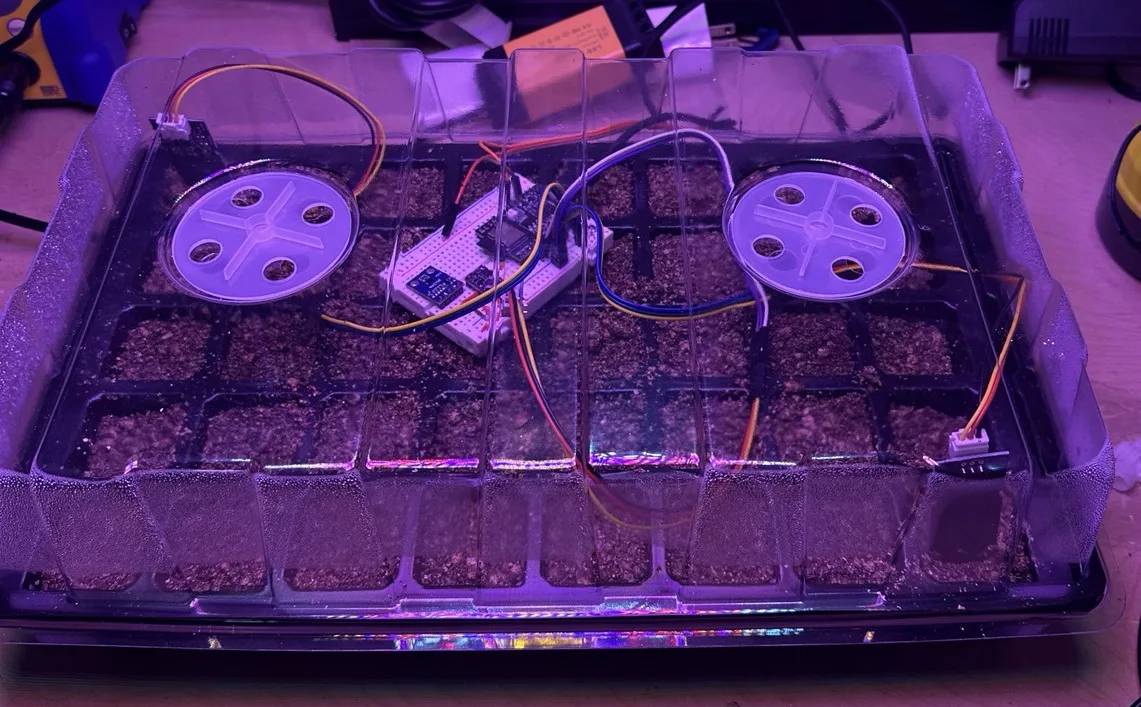
The incubator is a 40-cell tray inside a solid bottom tray. A clear humidity dome covers it. It sits on a heat mat, under a light on a 16-hour cycle. Two changes from the bench node matter later:
- Three capacitive soil probes across the tray, and not one probe.
- A BME280 in place of the BMP280. A sealed dome makes humidity a value that you want.
The BH1750 now measures the light at canopy level. Each cell holds two seeds, so one germination failure does not confuse the result.
This firmware also has outputs. The grow light is an entity that we control from 0 to 255. The firmware also has a high temperature alert and a low temperature alert. That is the line between an instrument and a chamber.
How we chose a crop
We wanted the fastest honest signal. We therefore chose the crop for its germination behavior, and not for its food value.
Peppers need soil at 27-29 °C (80-85 °F), and they germinate in 14 to 30 days or more. That is too slow for this test. Mint and rosemary grow from cuttings. True peppermint is a sterile hybrid. Rosemary seed germinates at about 30%, and it takes weeks. Cilantro has a taproot that does not tolerate transplanting, and heat makes it bolt. You must sow cilantro direct, so cilantro does not use an incubator.
Arugula and dill germinate in 5 to 10 days. They tolerate a range of conditions, and they transplant well.
The reasoning transfers to a pod. The same three properties constrain a pod’s crop list:
- The germination time.
- The transplant tolerance.
- Whether you can start the crop in one cell and finish it in another.
The fault that the light sensor found
We first used a WS2812B strip on the dome. The BH1750 measured about 572 lux at tray level. Seedlings need 2,000 to 3,000 lux. The strip therefore delivered three to five times too little light. Your eye cannot see this deficit, because a strip of LEDs at close range looks bright.
The timeline made the finding useful. Arugula and dill do not need light to sprout. Days 1 to 7 would therefore look correct. The failure arrives in week two as etiolation. The seedlings become pale and long. They stretch toward the light. They then fall over before they make true leaves. You must fix the light about 5 to 7 days after you sow. When the damage becomes visible in the tray, that window is closed.
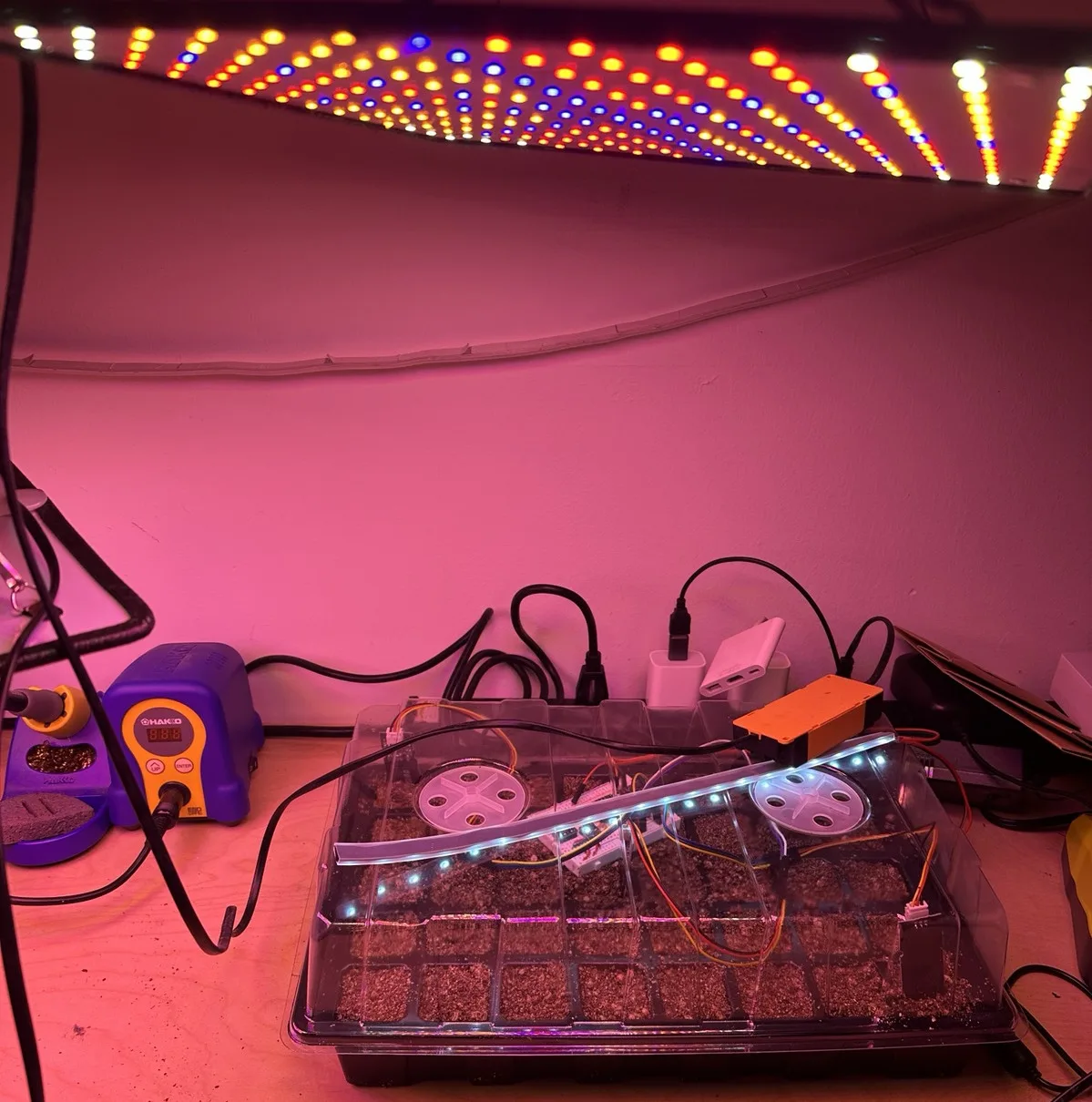
We changed to a quantum-board light on a smart outlet, which keeps the 16-hour schedule. Tray level then measured about 3,000 lux. The sensor changed a crop failure two weeks away into a parts problem the same day.
State the ceiling precisely. This hardware measured a lux-to-PPFD ratio. At that ratio, 3,000 lux is about 48 µmol m⁻² s⁻¹. That is sufficient for seedlings. A lettuce crop at maturity needs 200 to 500 µmol m⁻² s⁻¹. This incubator therefore validates the control loop. It does not validate a flight light budget. Light is also the largest line in a pod’s power budget.
What an agent did with the telemetry
The agent that read the tray transfers to a pod more than the tray does.
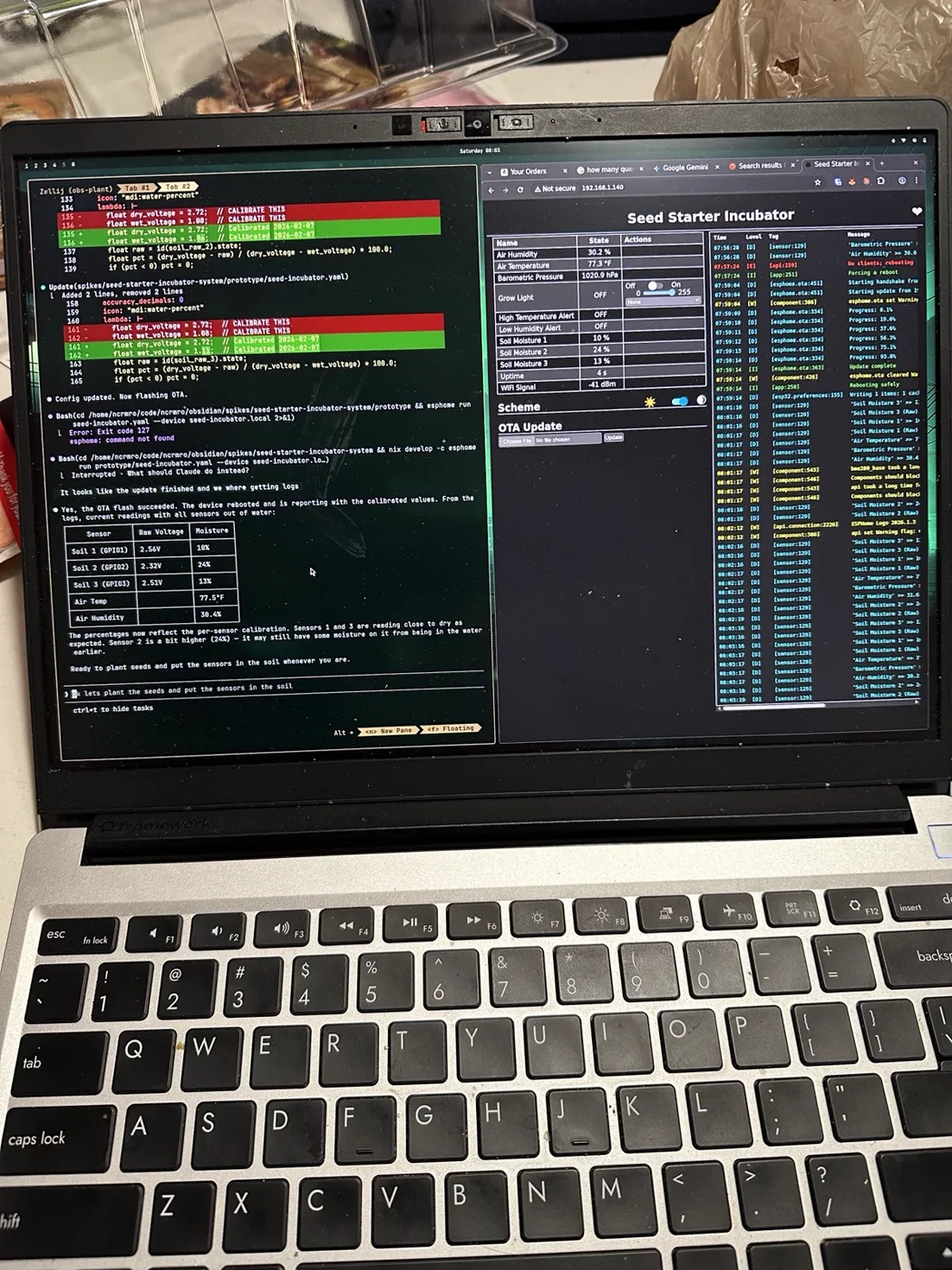
Each capacitive soil probe needs its own calibration, because the dry voltage and the wet voltage differ for each probe and board. The agent did four things:
- It edited the calibration constants in the device YAML.
- It flashed the firmware over the air.
- It read the values back.
- It interpreted the values:
The percentages now reflect the per-sensor calibration. Sensors 1 and 3 are reading close to dry as expected. Sensor 2 is a bit higher (24%) — it may still have some moisture on it from being in the water earlier.
Three numbers (10%, 24%, and 13%) became an assessment. The agent said which readings you can trust. It also explained the one odd reading, and it showed that the probe is not broken.
This answers the gap at the end of the sensor-platform test. A pod has no person who watches a dashboard. Detection becomes useful only when something turns the numbers into a statement: this channel is wrong, and here is why. Do this first at a bench, where the ground truth is a tray that you can look at. Then you learn whether the guidance is correct, before you trust it at a distance.
What the run showed
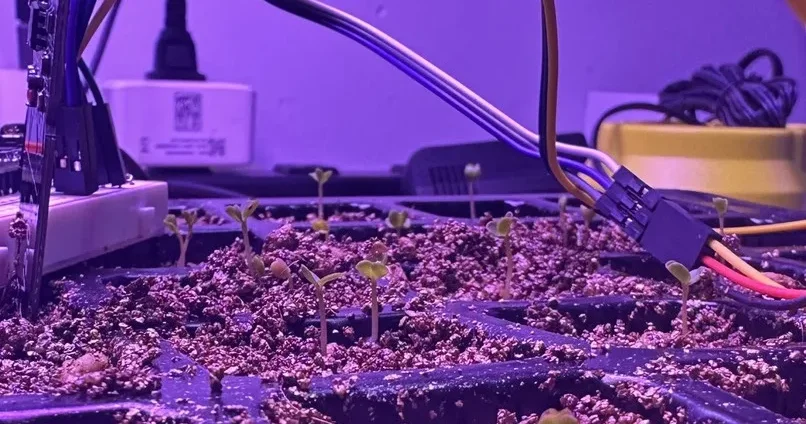
The first sprouts appeared on day 5. They were arugula, as we expected. Dill followed one or two days later. Most cells showed growth by day 8.
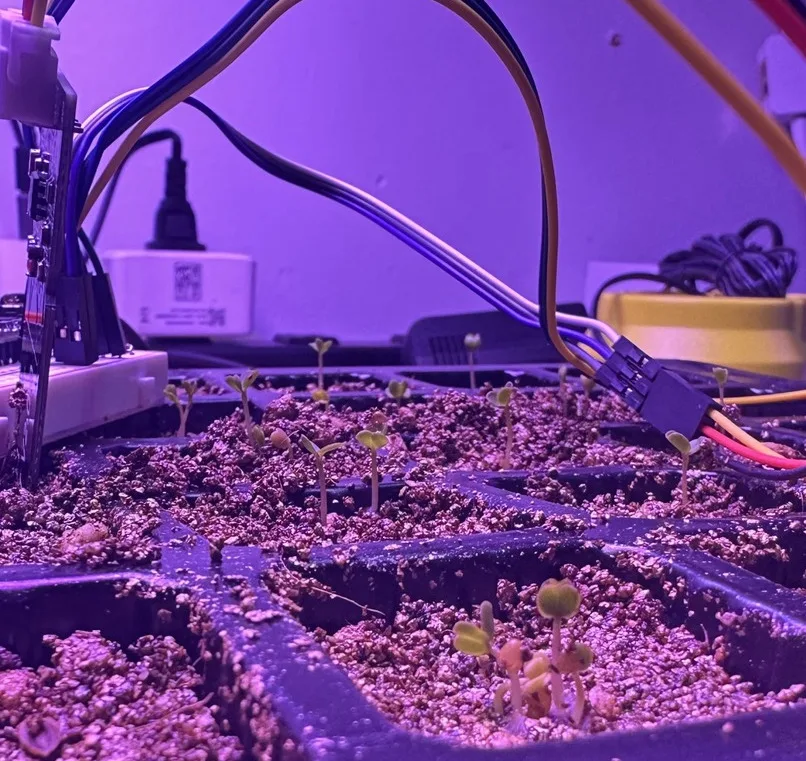
The light fault is the first finding. The sensors settled two more that a guess would not.
The humidity dome works. The BME280 inside the dome measured 75-85% relative humidity. The room measured 35-40%. We therefore watered from below once in ten days, and not every two or three days.
Night temperature drops are real, and the mat handled them. The room fell to 20 °C (68 °F) overnight. The mat held the soil near 24 °C (75 °F). Without the measurement we could not know if the mat compensated or only ran.
What this does not prove
Ten days of germination is the first data against the 30-day uptime bar from the sensor platform. It does not pass that bar.
The actuation here is a grow light on a schedule. It is not a closed loop. Nothing yet changes the light or the water because of a reading.
The agent worked interactively. A human was present, and the tray gave the ground truth. That is far from an agent that we trust to interpret telemetry from a machine that nobody can walk to.
Next we test the slower crops that need precise temperature control. We also collect a baseline for each crop. The baseline must be long enough to make “this reading is abnormal” mean something. Both steps lead to one thing: a chamber that finds its own faults before a person would.
We measured the sensor readings and the germination dates on our own hardware. The expected germination windows and the light thresholds are standard horticultural references. They are not our measurements.