Astrobotany and the Hunt for VRE
A leaf is dark in red light and bright in infrared, and it changes its mind across about fifty nanometres. Reflectance jumps by roughly an order of magnitude between 700 and 750 nm — not a tint but a cliff, and a cliff is something an instrument can find at a distance no telescope will ever resolve into a picture of a plant.
That is the whole premise of looking for life by colour. You never see the leaves. You take the light a planet throws back, spread it by wavelength, and ask whether the curve breaks where chlorophyll breaks it.
The break has a name — the vegetation red edge, VRE — and it is the only biosignature we have that a leaf makes on purpose. A century of hunting it has produced one, on one planet, seen by a spacecraft that was already leaving it.
Coloured glass, pointed at Mars
A Russian astronomer put coloured glass in front of a telescope and searched Mars for chlorophyll. He did not find it.
The filters were the experiment. Each one admits a band and rejects the rest, so comparing plates through different glass is a way of asking how a planet’s brightness changes with wavelength — a spectrum assembled one colour at a time, decades before anyone could record the curve directly.
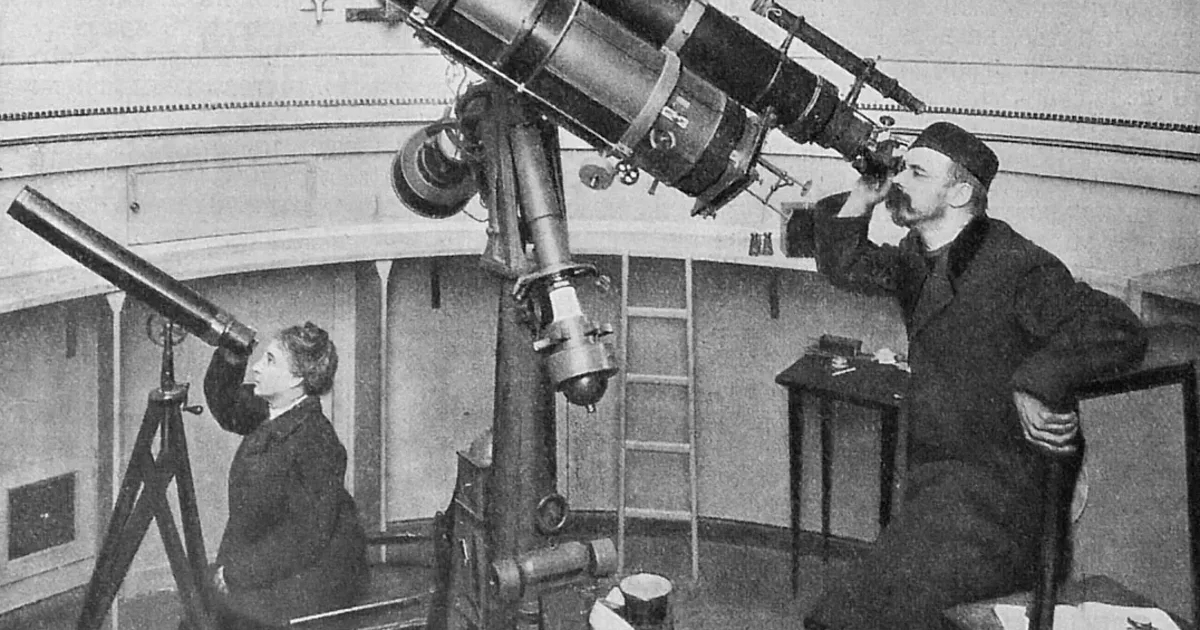
The photograph at the top is Tikhov and his wife at the Bredikhin astrograph, Pulkovo Observatory, 1912 — six years before the Mars observations, on the instrument class he later put filters on. Нива no. 17, 1912, public domain via Wikimedia Commons; cropped to the dome, nothing within the frame removed.
The search gets a name
Gavriil Adrianovich Tikhov spent the decades after the null result declining to believe it — Martian plants must simply be a different colour, blue, mostly mosses and lichens — and then named the field he had been working in alone. Astrobotany.
A spacecraft looks back and finds us
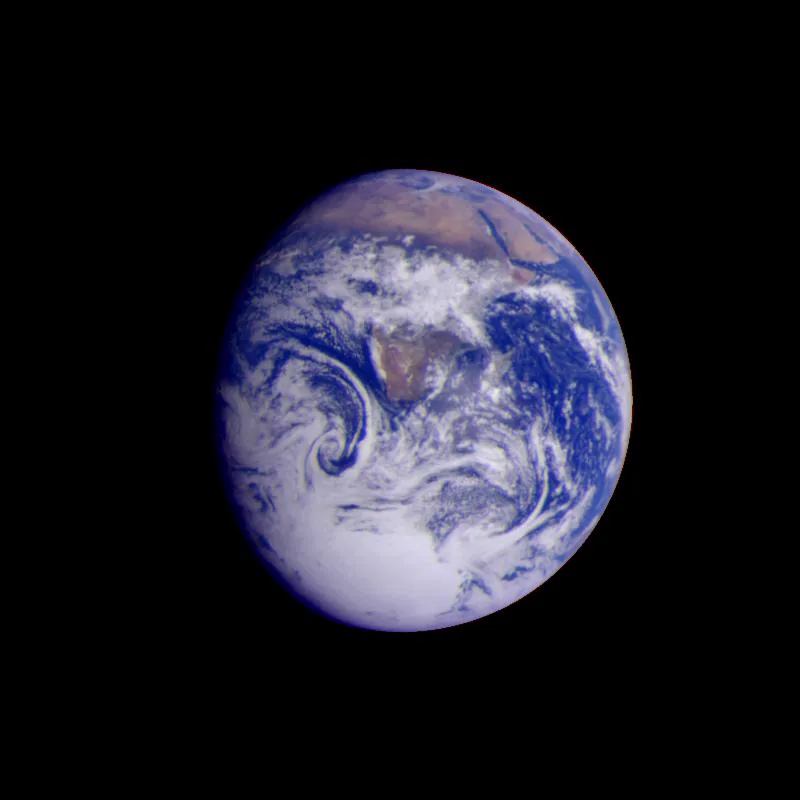
The planet in question, from the spacecraft in question — about 1.5 million miles out, Africa up the middle of the disc. NASA/JPL PIA00076, public domain. The Galileo spacecraft flew past its own home planet en route to Jupiter, and Sagan and co-authors turned the instruments on it to ask what a visiting probe would conclude. Their answer, in Nature in 1993: “abundant gaseous oxygen, a widely distributed surface pigment with a sharp absorption edge in the red part of the visible spectrum, and atmospheric methane in extreme thermodynamic disequilibrium”.
The middle item is chlorophyll — Tikhov’s target, seen from a spacecraft, seventy years later. It is not a detection. The conclusion rests on all three signals together and the paper says “strongly suggestive of life”, never proof.
The signal gets a name, and a caveat
Seager and colleagues named the step function the vegetation red edge (VRE) and argued it could betray a biosphere across interstellar distance. The same review is blunt about why the pigment alone will not do it: some mineral reflectance edges mimic the shape closely enough to fool you.
A greenhouse flies alone, and never waters a seed
Someone finally tried to make a red edge instead of hunt for one. DLR put two greenhouses inside a free-flying satellite, spun it to produce Moon gravity and then Mars gravity, and loaded it with tomato seeds, Euglena, and synthetic urine for fertiliser.
In January 2019 a routine software update put both greenhouses into safe mode. Engineers spent eleven months rebooting modules from the ground and never recovered them. DLR’s own farewell release says “the greenhouses and their technologies are still functional, but that irrigation cannot be initiated”. The mission closed on 31 December 2019 with zero on-orbit plant biology: two greenhouses quiescent in orbit, a bus that outlived its payload.
It lacked somebody aboard to reach in and unstick a command path.
So the method works and the answer is empty. The cliff is real, it survives the trip to interplanetary distance, and an instrument built for other things caught it on the first honest attempt — pointed at the one planet that already had leaves.
That is the result. A century of looking has not found one anywhere but home, so if we want a red edge somewhere else, we put it there.
The plants go first
The novelty is food that can be there before anyone is — growing while the crew is still on the pad, harvested before they arrive.
Nobody has done that, and the flight record shows why it never came up. Every unambiguous crop success in that record had a human in the room. Veggie’s lettuce and mizuna, the Advanced Plant Habitat’s radish and peppers, EDEN ISS through a polar winter — all of it tended by people who were already there, and already fed by the resupply that brought the seeds. The food has always followed the humans.
The two serious attempts to grow plants where nobody was went the other way. Eu:CROPIS never irrigated a seed. Chang’e-4’s cotton sprouted on the Moon and was switched off when the first lunar night arrived, by design.
That is the target: supply placed ahead of the mission, the way a polar expedition lays depots along a route before anyone walks it. It changes what a mission can attempt, because it takes food off the crew’s launch manifest entirely. Whether it is still food when somebody arrives is the open question.
Today that is a statement of intent rather than capability. What exists is a ground analogue that reports, and no flight: no orbit chosen, no destination, no bus. But it fixes the target precisely. The first vegetation red edge anyone sees off Earth will not be found by a telescope. It will be one we put there — and to be worth anything, it has to be there before we are.
References
- Gavriil Adrianovich Tikhov and Astrobotany — English Wikipedia, retrieved 2026-08-12, citing Danielle Briot, “The Creator of Astrobotany, Gavriil Adrianovich Tikhov”, in Astrobiology, History, and Society, Springer 2013. doi:10.1007/978-3-642-35983-5_8
- Sagan, Thompson, Carlson, Gurnett & Hord, “A search for life on Earth from the Galileo spacecraft”, Nature 365, 1993. doi:10.1038/365715a0
- Seager, Turner, Schafer & Ford, “Vegetation’s Red Edge: A Possible Spectroscopic Biosignature of Extraterrestrial Plants”, Astrobiology 5(3), 2005. doi:10.1089/ast.2005.5.372
- Xie, Yang, Xu, Zhang, Qiu & Ding, “The first biological experiments on the lunar show that low gravity conditions will acclimate to super-freezing”, Research Square preprint, 2023 — not peer reviewed. doi:10.21203/rs.3.rs-2372108/v1
- Dambowsky, Eßmann, Hauslage & Berger, “Farewell to the Eu:CROPIS mission”, German Aerospace Center (DLR) mission news release, 13 January 2020. dlr.de